The Cybercab Itself: No Controls, Two Seats and No Cable
Removing the steering wheel is the decision every other Cybercab choice follows from, including the ones that look purely cosmetic.
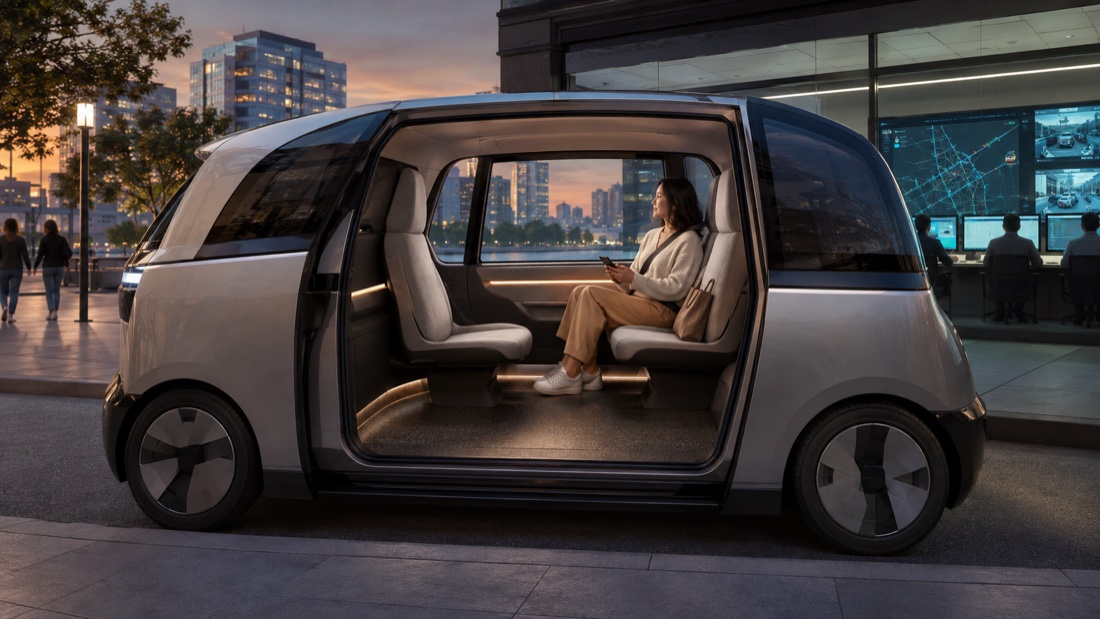
A car with no steering wheel is not a car with a part removed. It is a different regulatory object, a different crash case, a different evacuation problem and a different passenger relationship. Once the controls go, the seating, the doors, the luggage space and even the charging method are free to be designed around riders and fleets rather than drivers.
The eight claims here describe the vehicle as shown. They belong together because they share two dependencies: an approval regime that does not yet treat a control-free vehicle as routine, and an operating model in which no human is ever available to plug the car in, open a stuck door or take over.
How to read these claims
A robotaxi programme mixes four kinds of statement: a vehicle design shown at an event, a capability demonstrated in a supervised service area, a company target, and a service a member of the public can actually book today. Tesla's pages change as the fleet, software, service areas and terms change, so every claim below is bounded by what was documented on the access date rather than by what may be true in another city or a later release.
- a control-free cabin
- two-passenger layout
- butterfly doors
- enclosed cargo storage
- inductive charging
- 48-volt electrical architecture
- weight and motor specification
- battery size and range
A control-free cabin
Confirmed as Cybercab design intent: Tesla's Q3 2024 disclosure says Cybercab and Robovan were designed from the ground up for autonomy without a steering wheel or pedals. The live Robotaxi service, however, currently starts with Model Y vehicles.
The source says Cybercab is built without a steering wheel, accelerator, brake pedal or gear selector.
Removing controls changes homologation, fallback behavior, emergency response, cabin packaging and the definition of who can command the vehicle. It is not merely an interior-design choice.
What remains unpublished. Market approvals, fallback hardware, manual recovery interface, towing procedure, accessibility implications and final customer-fleet configuration vary or remain unpublished.
A fair test. Review production certification and emergency guides, then test pull-over, immobilization, towing, passenger misuse and remote-support failure without assuming a human can take the wheel.
Two-passenger layout
The two-seat form is visible in Tesla's Cybercab presentation, but dimensions, occupancy demand assumptions and final fleet mix require production documents. Current Robotaxi rides use Model Y, not a two-seat Cybercab.
The pasted feature calls Cybercab a compact two-seat coupe designed to maximize cabin room while minimizing footprint.
Two seats can reduce mass and frontal area but exclude many group trips. Fleet utilization depends on matching vehicle capacity to actual party-size and accessibility demand.
What remains unpublished. Final dimensions, seat travel, child-restraint policy, luggage interaction, wheelchair offering and how dispatch handles parties larger than two remain incomplete.
A fair test. Measure real party-size rejection, ingress, comfort, luggage fit and vehicle miles per passenger against a Model Y fleet over matched service areas.
Butterfly doors
Prototype imagery supports the door form, but a photographed mechanism is not a final clearance, durability or production specification.
The source describes top-hinged butterfly doors intended to ease entry in tight curb spaces.
Upward doors move the clearance problem from lateral swing to overhead and diagonal space. They must detect people, branches, garage ceilings and adjacent street furniture while remaining usable after a crash or power loss.
What remains unpublished. Opening envelope, sensor coverage, manual release, ice behavior, cycle life, wind limits and production latch design are unpublished.
A fair test. Test curb, garage, rain, ice, crosswind, blocked-door and post-impact scenarios with passengers of different mobility and reach.
Enclosed cargo storage
The visible body shape supports an enclosed rear volume, but public materials do not establish final cargo capacity, security or the causal claim that omitting glass creates the trunk.
The source links Cybercab's fastback form and absent rear window to a secured luggage compartment.
Robotaxi cargo design must balance bags, visibility systems, intrusion resistance, forgotten-item inspection, cleaning and emergency access without a driver to supervise loading.
What remains unpublished. Production cargo volume, opening dimensions, load limit, release, camera coverage, weather sealing and oversized-item policy are unpublished.
A fair test. Load representative airport and grocery trips, test retrieval and lost-item detection, and verify emergency opening, drainage and impact behavior.
Inductive charging
Tesla has presented inductive charging as part of the Cybercab concept, but public production efficiency, power, alignment and interoperability specifications are still needed.
The source says Cybercab replaces a plug with an underbody wireless charging pad so it can charge without a person.
A driverless fleet needs unattended energy transfer. Inductive charging removes robotic plug handling while adding alignment, coil losses, foreign-object detection, thermal management and depot civil work.
What remains unpublished. Charge power, efficiency curve, ground clearance, alignment tolerance, pad standard, weather rating, installation cost and fault recovery remain unclear.
A fair test. Measure wall-to-battery efficiency, alignment success and thermal behavior across weather, debris and repeated autonomous arrivals, including failed-charge recovery.
48-volt electrical architecture
This is plausible engineering inference from Tesla's newer vehicle work, not a sufficiently documented Cybercab production specification in the primary sources reviewed.
The pasted list says Cybercab inherits a 48-volt low-voltage system that reduces copper and manufacturing complexity.
Higher low-voltage distribution can reduce current for a given power and therefore conductor area, but every controller, motor, lamp, connector and service procedure must fit the architecture.
What remains unpublished. Bus voltage, zonal controllers, conversion stages, wire-mass saving, component availability, fault protection and service isolation are unpublished.
A fair test. Inspect production schematics and bill of materials, then measure harness mass, conversion loss, fault containment and repair time against a defined baseline.
Weight and motor specification
These precise values are not confirmed by the Tesla primary sources reviewed and should not be published as settled production specifications.
The source assigns Cybercab a curb weight near 3,113 pounds and a single 219-horsepower motor.
Mass and power influence energy use, acceleration, tires, braking, crash structure and fleet cost. A robotaxi needs adequate merge and grade performance, but excess peak power can add cost and reduce efficiency.
What remains unpublished. Certified curb mass, payload, axle loads, motor rating, drivetrain configuration, performance and fleet configuration remain unpublished.
A fair test. Weigh an identified production vehicle and run instrumented acceleration, grade, payload, thermal and energy tests with the exact software and tires.
Battery size and range
Neither the 48 kWh capacity nor a 300-mile production range is established by the official sources reviewed. They are estimates, not customer or regulatory labels.
The pasted list says a roughly 48 kWh battery delivers close to 300 real-world miles through high efficiency.
Fleet range depends on usable energy, route speed, weather, HVAC, charging reserve, cleaning trips, deadhead miles and battery aging. A small pack can improve cost and utilization only if charging and demand are coordinated.
What remains unpublished. Gross and usable capacity, chemistry, certified range, consumption, charging curve, reserve policy, degradation and warranty are unknown.
A fair test. Measure wall energy and accepted passenger miles across seasons and shifts, separating occupied, repositioning, depot and charging losses.
The claims above were checked against Tesla Robotaxi, Tesla Robotaxi support, Tesla Robotaxi terms, Tesla Robotaxi privacy notice, Tesla We, Robot, Tesla Q2 2026 update, Tesla Q1 2026 update, Tesla Q3 2024 update, accessed September 2, 2026. These statements describe the documented service and product programme at that date. They are not a promise that the same vehicle, operating area or rider rule applies in another place or in a later release.
Bottom line
The Cybercab is coherent as a design and unproven as a product. Two seats, wide doors, a locked boot and a charging pad make sense for short urban rides run by a fleet; they also concentrate every failure into scenarios where no occupant can intervene.
The documents worth waiting for are the exemption or standard it is certified under, the emergency egress procedure, and the energy numbers - pad-to-pack efficiency, charge time and consumption per mile - that the whole robotaxi economic argument quietly depends on.