Hands, Touch and Whether Optimus Can Use Human Tools
The hand is the part of a humanoid that decides whether it can do a job at all, and the part with the least published specification.
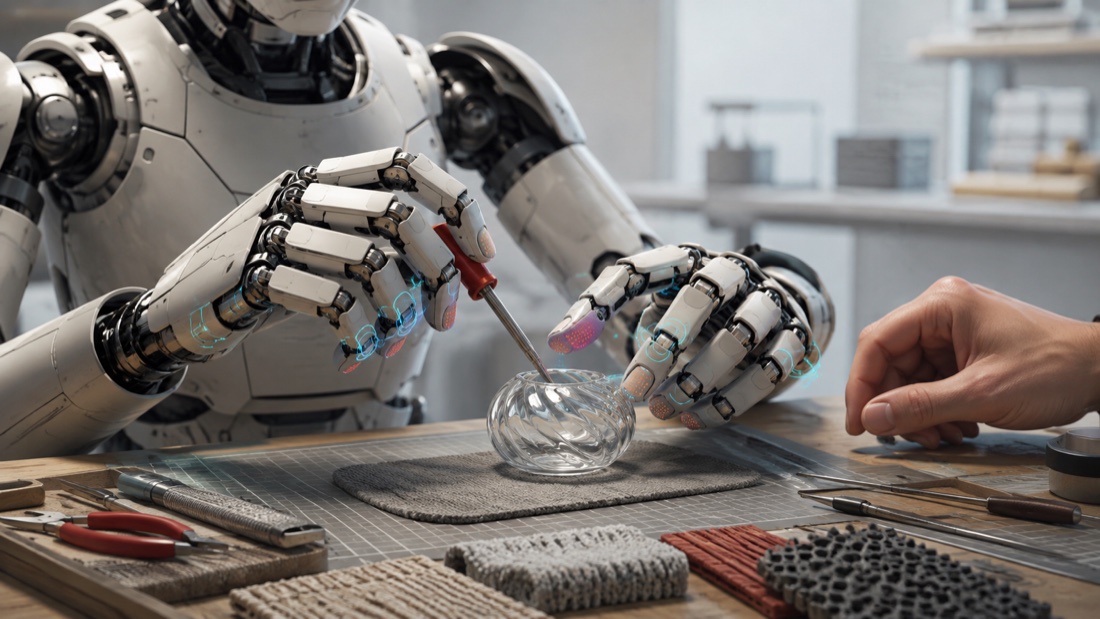
A humanoid form is justified almost entirely by the hand. If the robot cannot pick up the tools, fittings and packaging that a workplace already contains, the human shape buys very little. That makes the hand claims the ones worth the most scrutiny and the ones with the least detail attached.
Degrees of freedom, fingertip sensing, delicate handling and tool use are four statements about the same subsystem, and the interesting question is not how many joints a hand has but what it can do repeatedly without looking, without crushing, and without dropping.
How to read these claims
Four things are easy to conflate here: an early design target, a capability shown by a development robot, a statement about the Gen 3 production programme, and a specification a customer could rely on. Tesla has been clear about the programme and its production intent, but has not published a Gen 3 datasheet, price list, warranty or public delivery schedule. A detail presented in 2022 may explain an engineering direction without describing the hardware on a 2026 line, and a polished video may demonstrate a task without revealing teleoperation, retries, fixture preparation or the size of the operating domain.
- hand degrees of freedom
- tactile fingertip sensing
- fragile object handling
- human tool use
Hand degrees of freedom
Tesla has confirmed that Gen 3 includes its latest hand design, but its 2026 shareholder materials do not publish those exact counts as a released production specification. Keep them labeled as development claims.
The source assigns 22 degrees of freedom and as many as 25 micro-actuators to each next-generation hand.
Hand dexterity depends on controllable axes, tendon or gearbox transmission, sensing, fingertip geometry, force bandwidth, durability and planning. A larger joint count does not guarantee reliable grasps.
What remains unpublished. Final axes, actuator placement, passive coupling, payload, cycle life, replacement procedure and API access are unknown.
A fair test. Run a repeatable object set covering pinch, power, lateral and in-hand manipulation, then measure success, time, force, damage and maintenance across thousands of cycles.
Tactile fingertip sensing
Tesla has shown and discussed increasingly capable hands, but a complete Gen 3 tactile sensor map and specification are not public. The per-finger wording should remain provisional.
The source claims that every finger contains sensors for force, pressure and touch position.
Tactile sensing can detect first contact, estimate slip and regulate grip where vision is occluded. Its value depends on resolution, range, latency, drift, durability and the control policy consuming the signals.
What remains unpublished. Sensor coverage, taxel count, force range, sampling rate, temperature drift, replaceable skin and calibration method remain unpublished.
A fair test. Use calibrated forces, textures, edges and incipient-slip trials over temperature and wear, measuring localization error and whether control responds before the object moves.
Fragile object handling
A demonstration can prove that one prototype completed one carefully prepared action. It does not establish a general fragile-object rating, autonomy level or production success rate.
The list cites eggs and watering plants as evidence that Optimus can manipulate fragile objects without crushing them.
Fragile handling combines perception, grasp selection, contact sensing, force control, motion planning and recovery. Spilling, dropping and collision can matter more than crushing force.
What remains unpublished. Object preparation, teleoperation involvement, number of attempts, success rate, force trace, lighting and failure cases are usually absent from short demonstrations.
A fair test. Pre-register a mixed object set and success criteria, record every attempt and intervention, then measure damage, spill, drop and completion rates under varied placement.
Human tool use
Human-like geometry is a design strategy, not proof of universal tool compatibility. Tesla has not published an approved tool catalog or production task envelope.
The source argues that human-sized hands let Optimus operate ordinary tools, door handles and factory equipment.
Tools assume human grip compliance, wrist motion, vision, judgment and feedback. Powered tools also introduce kickback, sharp edges, cords, dust, vibration and emergency controls.
What remains unpublished. Permitted tools, grip adapters, torque limits, trigger operation, protective equipment, supervision and validation requirements remain unknown.
A fair test. Qualify each tool-task pair with fixtures, forces, failure modes and stop paths; do not infer approval for one tool from successful use of another.
The claims above were checked against Tesla Master Plan Part IV, Tesla Q2 2026 shareholder update, Tesla Q4 2025 shareholder update, Tesla Q2 2024 shareholder update, accessed September 2, 2026. Tesla calls Optimus a general-purpose autonomous humanoid, reported autonomous tasks in one of its facilities in 2024, and said in July 2026 that first-generation production lines were being installed in anticipation of production in 2026. Its January 2026 update called Gen 3 the first design intended for mass production. Capacity, production, customer deliveries, public availability and a stable retail product are different milestones.
Bottom line
Manipulation is where robotics demonstrations most often outrun deployment. A hand that succeeds nineteen times in twenty is a hand that fails several times an hour in a real shift.
The evidence to ask for is boring and decisive: success rate over hundreds of attempts, with the object set published, the failure modes described, and the recovery behaviour shown when a grip slips.