Sub-One-Second Acceleration and Thruster-Assisted Handling
A launch time is arithmetic once the protocol is fixed. These three claims are about force that does not pass through the tyres, and what that changes.
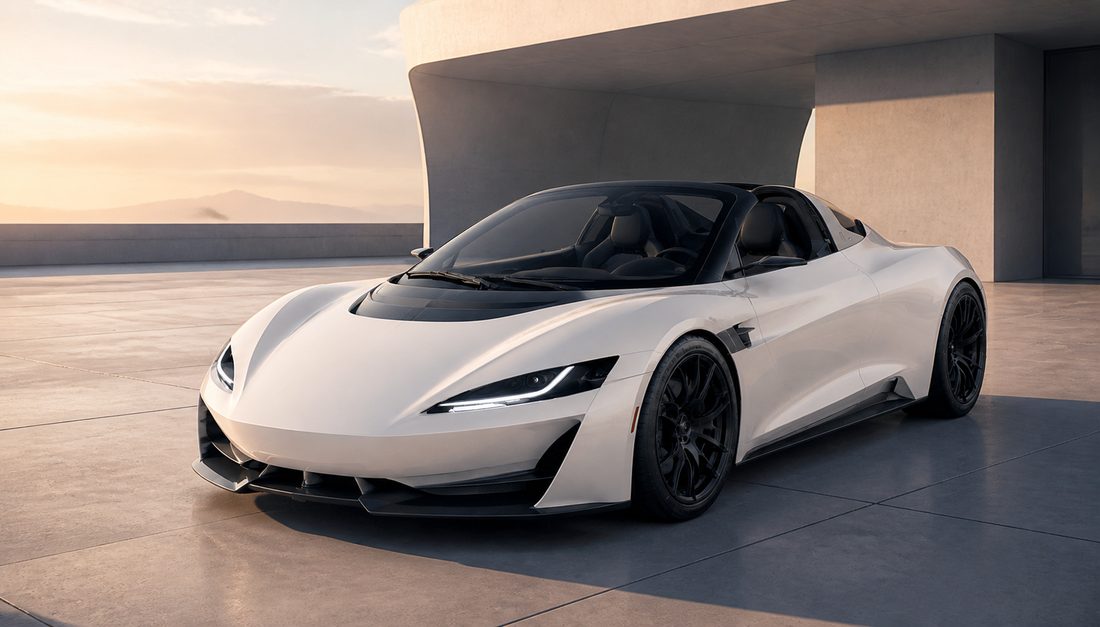
Every claim in this group turns on one idea: a tyre can only transmit so much force, and a jet does not care. That is genuinely interesting, and it is also where careless comparison starts. A launch assisted by stored gas is not the same kind of measurement as a launch that depends only on grip, and a car that can do it once is not a car that can do it repeatedly.
Tesla publishes 1.9 seconds to 60 mph. Everything faster than that comes from executive statements. The gap between those two positions is where the interesting engineering questions live: what the occupant experiences, what the structure carries, what the reservoir has left, and what the car does when the assistance stops mid-corner.
The test protocol matters as much as the number, so each claim below is paired with the measurement that would settle it.
How to read these claims
The Roadster is an upcoming vehicle, so its specifications come from several sources of very different weight. A manufacturer publication, a statement made at the 2017 unveiling, an executive remark, a feature visible on a show car and an engineering inference are not interchangeable, and this series keeps them labelled rather than blending them into one description.
Each claim below is given its evidence class, the physics or engineering it would depend on, the specifications that remain unpublished, and the test that would settle it. Where a number exists, its measurement boundary is stated: energy at the pack or at the charger, torque at the motor or at the wheel, range on a cycle or at a steady speed.
| Claim | Status | Strongest evidence |
|---|---|---|
| Sub-One-Second 0–60 MPH: Claim, Physics and Timing | Executive target; not a demonstrated production specification | Executive statement |
| Thruster-Assisted Cornering and the Traction Circle | Engineering inference; no published control specification | Inference and expectation |
| Thruster-Assisted Braking Beyond Tires and Regeneration | Engineering inference; no published braking specification | Inference and expectation |
Cold-gas systems are not exotic and do not need combustion. They expel stored mass at velocity, and the decisive values are thrust, specific impulse, reservoir pressure, gas mass, duty cycle and total impulse. Until those are public, an animation establishes an idea rather than the capacity of a customer vehicle or the number of times it can repeat a manoeuvre.
Sub-One-Second 0–60 MPH: Claim, Physics and Timing
Executive target; not a demonstrated production specification.
The source presents a roughly 0.9-to-1.1-second launch as a SpaceX-package capability.
Tesla publishes 1.9 seconds from zero to 60 mph on its Roadster page. The company page does not publish a sub-one-second time or the test conventions that would govern such a result.
Reaching 60 mph in one second implies average longitudinal acceleration near 2.7 g before accounting for rollout conventions. Tire force alone is constrained by load and friction; a rearward thruster could add force that does not pass through the contact patch, but the occupant, seat, restraints, structure and loose objects still experience the acceleration.
What remains unpublished. Unknowns include rollout, surface preparation, tire state, reservoir state, launch mass, slope, wind, repeatability and whether the number is a peak demo or a warrantied customer mode.
A fair test. Use independent two-way timing with and without rollout, a surveyed level surface, full mass disclosure, repeated runs and published invalidation rules. Report 0–60, 0–100, quarter-mile trap speed and reservoir depletion together.
Thruster-Assisted Cornering and the Traction Circle
Engineering inference; no published control specification.
The source says lateral gas propulsion could pivot the Roadster into tight corners at track speed.
Tesla describes aerodynamic efficiency but does not publish lateral thrusters, yaw moments, cornering gains or a track mode that uses compressed gas.
A lateral nozzle could add side force or yaw moment independently of tire friction. Its benefit depends on location relative to the center of mass, response time, remaining gas and coordination with steering, braking and motor torque. A sudden off-axis pulse could also destabilize the car when a tire is near its grip limit.
What remains unpublished. No nozzle geometry, thrust vector, control law, failure mode, driver interface or lap-time evidence is public. The phrase ‘forcefully pivot’ is not an engineering requirement and says nothing about predictability.
A fair test. Publish steady-state skidpad, transient lane-change and instrumented track results with the system on and off. Include yaw rate, sideslip, steering angle, tire temperatures, gas consumption and safe degradation after a nozzle or sensor fault.
Thruster-Assisted Braking Beyond Tires and Regeneration
Engineering inference; no published braking specification.
The source proposes forward-facing thrust to supplement friction brakes and regenerative braking.
Tesla does not publish a thruster-assisted stopping distance, reservoir requirement or braking-system architecture for the Roadster.
A forward-facing jet could create longitudinal deceleration without asking the tires for the same force, but it would have to coordinate with ABS, stability control, regenerative torque and hydraulic brakes. Occupant load, nozzle hazards and repeatable pressure state matter as much as the shortest single stop.
What remains unpublished. There is no evidence about activation logic, stopping-distance benefit, brake balance, minimum reservoir state, pedestrian protection, debris projection or what happens when the system is unavailable.
A fair test. Compare repeated 60–0 and higher-speed stops at full and depleted pressure, wet and dry, straight and split-friction surfaces. Measure deceleration trace, stability, temperatures, reservoir use and fault response—not only the best distance.
What this group of claims would cost the car
No feature lives alone. Additional battery energy affects mass, structure, cooling and charging. More downforce affects drag and range. A removable roof affects stiffness, sealing and storage. A pressure package affects seating, crash isolation, service and vehicle mass. Map each proposed benefit to what it consumes, and if a feature appears to produce a large benefit without consuming any currency, the missing cost is probably hidden in an unstated assumption.
The claims above were checked against Tesla Roadster product page and Tesla Semi and Roadster unveil, accessed August 31, 2026. A manufacturer page is a statement about an upcoming product, not independent certification, and the 2017 event documents reveal-era intent. Neither should be used to fill unpublished dimensions, materials, test conditions or production dates with assumptions.
Bottom line
Force from outside the contact patch is the most technically interesting idea in the Roadster programme, and the hardest to accept on a verbal description. It changes the shape of the performance envelope, the consumables a driver manages, and the failure modes an engineer has to design for.
The claim to watch is not the headline time. It is repeatability: the second and third run, warm, with a depleted reservoir, on a surface anyone can inspect, timed by someone who does not work for the manufacturer. A single spectacular number tells you a boundary was touched once. Ownership is decided by the run after that.