620 Miles and Fast Charging: Two Numbers That Need Conditions
Range and charging are functions, not numbers. Both are quoted as single figures, and both change completely with the conditions nobody has published.
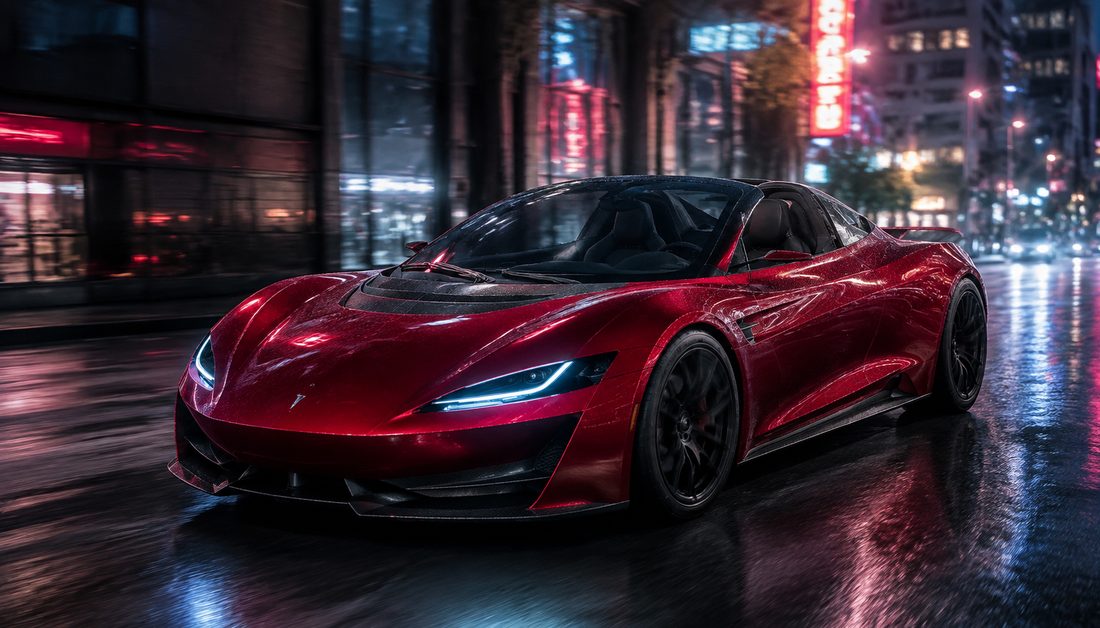
Range and charging are the two specifications an owner actually experiences, and the two most often reduced to a single digit. A range figure without a test cycle is a point on an unlabelled curve. A charging figure without a curve is the height of one instant that may last seconds.
Tesla publishes a 620-mile target. It has published no Roadster charging rate at all; the figures in circulation are borrowed from other products or from expectation. The two interact, because a large pack takes proportionally longer to fill and the last third of a charge is always the slowest.
The sections below give each claim its measurement boundary, and say what would have to be published for either number to mean what readers assume.
How to read these claims
The Roadster is an upcoming vehicle, so its specifications come from several sources of very different weight. A manufacturer publication, a statement made at the 2017 unveiling, an executive remark, a feature visible on a show car and an engineering inference are not interchangeable, and this series keeps them labelled rather than blending them into one description.
Each claim below is given its evidence class, the physics or engineering it would depend on, the specifications that remain unpublished, and the test that would settle it. Where a number exists, its measurement boundary is stated: energy at the pack or at the charger, torque at the motor or at the wheel, range on a cycle or at a steady speed.
| Claim | Status | Strongest evidence |
|---|---|---|
| The 620-Mile Range Target Is Not an EPA Label | Published Tesla target; not an EPA-certified production result | Manufacturer publication |
| 350 kW Charging: Peak Input Is Not a Charge Curve | Unsupported expectation; no Roadster charging rate is published | Inference and expectation |
Battery headlines mix quantities that are not interchangeable. Gross energy is not usable energy; peak charging power is not a charging curve; cell dimensions are not a pack; and a laboratory chemistry is not a warranted automotive system. Range, acceleration and charging also pull the design in different directions, because a large energy store helps range while low mass and high power help performance.
The 620-Mile Range Target Is Not an EPA Label
Published Tesla target; not an EPA-certified production result.
The source calls the Roadster the first production EV expected to exceed 620 miles on a charge.
Tesla's Roadster page prominently publishes 620 miles. The page does not label that figure as a current EPA-certified production range, and no customer production vehicle is available for an EPA label test.
Range couples usable battery energy with speed-dependent aerodynamic drag, rolling resistance, temperature, accessories, tires and driving cycle. A low, efficient body can make a large pack travel far on a test cycle while sustained 250-mph operation would consume energy at a radically higher rate.
What remains unpublished. The applicable test procedure, usable capacity, wheel and tire configuration, temperature behavior, charging losses and production certification result remain unknown.
A fair test. Compare the final regulatory label with independent constant-speed and mixed-route tests. Record temperature, wind, elevation, tire pressure, payload, start/end state of charge and whether the test includes charging losses.
350 kW Charging: Peak Input Is Not a Charge Curve
Unsupported expectation; no Roadster charging rate is published.
The source says the Roadster is engineered for a 350 kW DC charging peak.
Tesla's Roadster page does not state connector, voltage, peak charging power, charging time or compatibility with a particular Supercharger generation.
Peak kilowatts describe one point on a curve. Time depends on pack voltage, current, temperature, starting state of charge, taper, station sharing and usable capacity. A 200 kWh-class pack could accept high peak power and still take substantial time to reach a high state of charge.
What remains unpublished. Pack voltage, connector, peak duration, 10–80 percent time, preconditioning, cold behavior, charging losses and station availability remain unpublished.
A fair test. Publish a full 5–95 percent power curve at defined ambient and starting temperatures, energy delivered, battery temperature, repeat-run behavior and the exact charger hardware. Compare miles added per minute only with a defined efficiency basis.
What this group of claims would cost the car
No feature lives alone. Additional battery energy affects mass, structure, cooling and charging. More downforce affects drag and range. A removable roof affects stiffness, sealing and storage. A pressure package affects seating, crash isolation, service and vehicle mass. Map each proposed benefit to what it consumes, and if a feature appears to produce a large benefit without consuming any currency, the missing cost is probably hidden in an unstated assumption.
The claims above were checked against Tesla Roadster product page and EPA EV range testing and Tesla Semi and Roadster unveil, accessed August 31, 2026. A manufacturer page is a statement about an upcoming product, not independent certification, and the 2017 event documents reveal-era intent. Neither should be used to fill unpublished dimensions, materials, test conditions or production dates with assumptions.
Bottom line
Neither figure is implausible. Both are incomplete in the same way: they describe a best case without the conditions that produced it.
An EPA label would settle range. A published charging curve, with the pack preconditioned and the ambient temperature stated, would settle charging. Until those exist, treat 620 miles as a manufacturer target and any charging number as an expectation - and be especially wary of adding them together into a road-trip claim, which multiplies two unknowns.